
Forklift Accident on a Staten Island Construction Site: How Labor Law § 200 and Negligence Claims Go Beyond Workers' Comp After a Leg Amputation

Updated: Aug 24
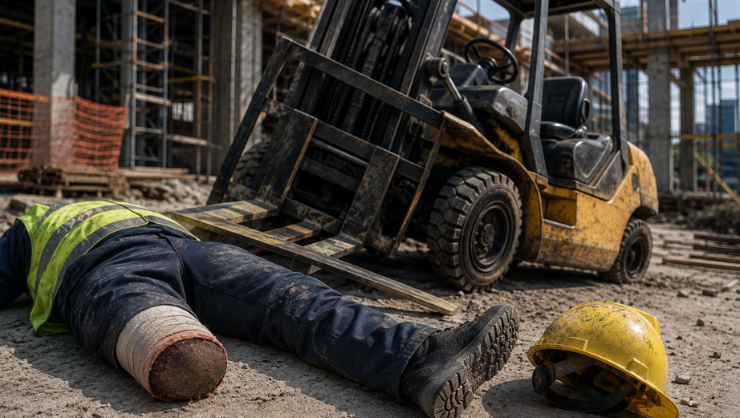
A telehandler backs up across a busy job site near the Matrix Global Logistics Park on Staten Island's West Shore. The operator — an employee of a different subcontractor — never checks behind him, and nobody assigned a spotter. The machine's rear wheel catches your leg and pins it against a stack of concrete block. Surgeons at Staten Island University Hospital fight to save the limb, but the crush damage is too severe, and you wake up with an above-knee amputation. A forklift accident on a Staten Island construction site like this one raises a question workers' comp was never designed to answer: who pays for the rest of your life?
Why Doesn't Workers' Comp Stop Your Lawsuit After a Forklift Accident on a Staten Island Construction Site?
Workers' compensation only blocks lawsuits against your own employer — it doesn't protect anyone else working on the site. Under Workers' Compensation Law § 11, comp benefits are the exclusive remedy against the company that actually employs you. But a modern NYC construction site is a patchwork of separate companies: an owner, a general contractor, and a dozen subcontractors who don't employ each other's workers.
That structure matters enormously. Under Workers' Compensation Law § 29, you keep the right to sue any negligent third party — meaning anyone other than your own employer — even while you collect comp benefits. If the forklift operator worked for a different subcontractor, his company is a third party. So is the general contractor that ran site logistics. So is the property owner.
Why does escaping the comp system matter so much? Because comp pays only your medical bills and a fraction of your wages — generally two-thirds of your average weekly wage, capped by statute. It pays nothing for pain and suffering, nothing for the loss of enjoyment of life, and nothing close to the true lifetime cost of an amputation. A third-party lawsuit is where those damages live.
The danger is real and well documented. The Bureau of Labor Statistics has documented forklift-related worker deaths nationwide in its fatal occupational injury data, and many more workers suffer serious injuries. We've covered the multi-party liability picture on Staten Island worksites before in our post on forklift accidents and OSHA violations. This post digs deeper into one specific escape route from the comp system: Labor Law § 200 and ordinary negligence.
How Does Labor Law § 200 Apply to Negligent Forklift Operation?
New York Labor Law § 200 requires that workplaces be constructed, equipped, arranged, operated, and conducted so as to provide reasonable and adequate protection for the lives, health, and safety of the workers on them. In plain English, it's the state's written version of the common-law duty to keep a job site reasonably safe, and it applies to owners and general contractors — not just your direct boss.
Courts analyze § 200 claims two different ways. The first is the "means and methods" theory: if your injury came from the way the work was performed — like a subcontractor's employee driving a telehandler in reverse through a pedestrian zone — the owner or general contractor is liable only if it had the authority to supervise or control that work. The New York Court of Appeals laid out this framework in cases like Comes v. New York State Electric & Gas Corp. and Rizzuto v. L.A. Wenger Contracting Co. The second theory covers dangerous premises conditions, which requires showing the defendant created the hazard or knew about it. We explained that second branch in our post on how Labor Law § 200 reaches hidden site defects.
A forklift strike usually falls under means and methods. That's why your lawyer's first job is proving control. Who set the site's traffic plan? Who scheduled deliveries through the area where laborers walked? Who was responsible for assigning spotters and flaggers? If the general contractor ran those logistics — and on most large Staten Island projects, it did — the control element starts to come together.
Federal safety rules sharpen the negligence case. Under 29 CFR § 1910.178, OSHA's powered industrial truck standard, employers must formally train, evaluate, and certify every forklift operator before letting them drive. OSHA treats untrained operation as one of the leading causes of forklift injuries. An OSHA violation doesn't automatically win your case, but New York courts let juries consider it as evidence of negligence — the concept we broke down in our plain-language guide to negligence.
Who Can You Sue When Another Subcontractor's Employee Was Driving the Forklift?
You can sue the operator personally, the subcontractor that employed him, and — depending on control and notice — the general contractor and the property owner. The most powerful of these claims is usually the one against the operator's employer, and it rests on a doctrine called respondeat superior. That's a legal phrase meaning an employer is automatically responsible for the careless acts its employees commit while doing their jobs. You don't need to prove the subcontractor itself did anything wrong; if its driver was negligent on the clock, the company answers for it.
The list of potential defendants often grows from there:
The subcontractor that employed the operator, through vicarious liability for his negligent driving
The general contractor, under Labor Law § 200 and common-law negligence, if it controlled site traffic and logistics
The property owner, if it created or knew about the dangerous condition or retained control over the work
The equipment rental company, if the machine had a defective backup alarm, bad brakes, or missed maintenance
Here's the part that surprises people. Most injured workers miss that a leg amputation is one of the few "grave injuries" listed in Workers' Compensation Law § 11 — which means the owner and general contractor can pull your employer back into the case for contribution, putting your employer's insurance carrier at the settlement table a second time and often accelerating resolution. We examined how strictly courts apply that grave-injury list in our post on the First Department's grave injury standard. For an amputation below the listed threshold, that door stays shut; for a lost leg, it swings open.
Venue matters too. A Staten Island accident belongs in Supreme Court, Richmond County, in St. George — a smaller, more tight-knit jury pool than the other boroughs, where jurors often know someone who works in the trades along the West Shore industrial corridor. Experienced lawyers watch for that dynamic when valuing the case and deciding whether to push for trial or settlement.
What Are Amputation Prosthetics and Vocational Retraining Damages Worth in New York?
A leg amputation case is valued around four pillars: lifetime prosthetic costs, ongoing medical care, lost earning capacity, and pain and suffering — and workers' comp fully covers none of them. This is why the third-party lawsuit, not the comp claim, determines whether your family stays financially whole.
Start with the prosthetics. A modern microprocessor-controlled prosthetic knee is a substantial expense for a single device, and prostheses aren't one-time purchases — sockets need refitting as your residual limb changes, and complete devices typically need periodic replacement for the rest of your life. Peer-reviewed research indexed on PubMed through the National Institutes of Health documents that lifetime prosthetic costs for a single above-knee amputee are substantial. Your lawyer will retain a life care planner to project every replacement cycle, every liner, every physical therapy course out over your remaining life expectancy, so the jury sees a concrete number instead of a guess.
Then comes the medical reality of living with the amputation. Walking with an above-knee prosthesis demands substantially more energy than natural gait, which is one reason many amputees develop secondary problems in the back, hips, and remaining leg. Phantom limb pain, skin breakdown at the socket, and revision surgeries all belong in the damages model.
Vocational retraining is the pillar insurers fight hardest. A 38-year-old laborer with an above-knee amputation almost never returns to fieldwork. A vocational rehabilitation expert will testify about what jobs you can realistically hold now, what retraining costs, and how long it takes — and an economist will calculate the gap between your union laborer earnings trajectory and your post-injury earning capacity, projected to retirement age. That gap alone frequently runs into the millions for a young tradesperson. Comp's two-thirds wage benefit doesn't come close, and it doesn't account for lost overtime, lost annuity contributions, or lost promotion tracks. For a broader look at how New York juries value catastrophic leg trauma, see our analysis of what a crush injury is worth in New York.
What Evidence Should You Preserve After a Staten Island Forklift Accident?
The single most important step is sending preservation letters — sometimes called spoliation letters — within days, before the machine gets repaired and the paperwork disappears. A spoliation letter is a formal demand that every company on the site preserve specific evidence; if they destroy it afterward, the court can punish them at trial. After a forklift accident on a Staten Island construction site, that letter should reach the operator's employer, the general contractor, the owner, and any rental company before the telehandler goes back into service.
Your lawyer will move fast to lock down:
The operator's training and certification records required by OSHA's powered industrial truck standard
Pre-shift inspection checklists and maintenance logs for the specific machine
The site safety plan, traffic control plan, and delivery schedules showing who controlled logistics
Daily reports, toolbox talk sign-in sheets, and incident reports from the day of the accident
Witness names, phone photos, and any camera footage from the site or neighboring properties
If OSHA opens an investigation, its findings and any citations become powerful ammunition — request them early, because they take time to obtain. Photographs of your leg injuries, the machine, and the accident location should be taken before conditions change.
Watch the clock. Under CPLR § 214, a personal injury lawsuit must generally be filed within three years of the accident. Your workers' comp claim runs on a much shorter track — you should notify your employer within 30 days. And don't forget that once your third-party case resolves, the comp carrier asserts a lien against the recovery under Workers' Compensation Law § 29, which your lawyer will negotiate down. Recent changes in New York practice, like the disclosure rules we covered in our post on New York's AVOID Act, also shape how these cases move once filed.
Before you talk to any insurance adjuster — yours or theirs — talk to a lawyer. Adjusters in amputation cases start building their defense the week of the accident. You should too.
Frequently asked questions
Can I still recover if I stepped into the forklift's path?
Yes. Under CPLR § 1411, your own carelessness doesn't bar your claim — it only reduces your damages by your percentage of fault. Even a worker found 30% at fault still recovers 70% of the verdict.
Does workers' comp get paid back from my settlement?
Generally yes. The comp carrier holds a lien on your third-party recovery for the benefits it paid, but the lien is reduced by its share of your attorney's fees and costs, and an experienced lawyer will negotiate it further. You still come out far ahead compared to comp benefits alone.
What if the forklift operator was never certified?
That's strong evidence of negligence against the operator's employer, since federal law requires formal training, evaluation, and certification before anyone operates a powered industrial truck. It also supports claims against the general contractor if site rules required verified operator credentials that nobody checked.
How long do I have to file a lawsuit?
Generally three years from the accident date for a personal injury claim in New York. But evidence disappears in weeks, not years — machines get repaired, workers scatter to new jobs, and footage gets overwritten — so the practical deadline for building a strong case is much shorter.
The Takeaway
Workers' comp is a floor, not a ceiling. When another subcontractor's forklift takes your leg on a Staten Island job site, Labor Law § 200, common-law negligence, and vicarious liability open the courthouse door to the full damages an amputation actually costs — prosthetics for life, retraining for a new career, and compensation for everything the injury took from you.
Written by Reza Yassi | LinkedIn
If you or someone you know suffered a serious injury in a forklift or telehandler accident on a New York construction site, the team at Yassi Law P.C. is ready to help. Call us today at 646-992-2138 for a consultation.
This article is for informational purposes only and does not constitute legal advice. Although I am an attorney, I am not your attorney, and reading this article does not create an attorney-client relationship. Laws vary by jurisdiction and may have changed since the publication of this article. For advice specific to your situation, consult a qualified attorney.

.png)