
LLC Buyout Valuation in New York: How Courts Price a Business Divorce

Updated: Aug 24
You and your partner built a Long Island City logistics company from a rented warehouse and a single box truck. Eight years later, the business clears $6 million a year, and you can't stand to be in the same Zoom call. One of you wants out. The other wants control. Now the only question that matters is what your share is actually worth — and that's where most New York LLC buyout valuation disputes turn ugly fast.
An LLC buyout valuation in New York is the process of pricing a member's interest when one owner exits and another stays in. It sounds technical. In practice, it's the single most important number in any business divorce, and it's almost always contested. At Yassi Law PC, we represent NYC and Long Island business owners in $1M–$10M disputes where the buyout price is the whole ballgame.
What is an LLC buyout in a New York business divorce?
An LLC buyout is a transaction — voluntary or court-ordered — where one member sells their membership interest to the company or to a remaining member instead of dissolving and liquidating the business. It's the off-ramp most owners actually want. Liquidation destroys going-concern value. A buyout preserves the operating business while letting one side cash out.
New York's LLC Law doesn't include a default buyout statute the way the Business Corporation Law does for closely held corporations. That's a critical asymmetry. If you're a 30% shareholder in a New York close corporation and the majority petitions to dissolve, BCL § 1118 gives you a statutory right to elect to buy the petitioner out at fair value. LLCs have no equivalent. There is no statutory buyout right.
That gap is why your operating agreement matters so much, and why so many fights end up in court. Most LLC operating agreements in New York either ignore valuation entirely or include a one-line formula — "book value" or "capital account balance" — that bears no relationship to what the business is actually worth. We dig into those drafting failures in our prior post on three operating agreement traps that can cost New York business owners millions.
How do New York courts order a buyout when the operating agreement is silent?
When the operating agreement doesn't provide a buyout mechanism, New York courts can still order one as an equitable remedy in a judicial dissolution proceeding. The vehicle is LLCL § 702, which authorizes dissolution when carrying on the business in conformity with the operating agreement is "not reasonably practicable." The leading case interpreting that standard is Matter of 1545 Ocean Avenue, LLC, 72 A.D.3d 121 (2d Dep't 2010), which directs courts to examine the operating agreement to identify the LLC's purpose and decide whether achieving it has become impossible.
Once a judge decides dissolution is warranted, the question becomes: dissolve and liquidate, or order one side to buy the other out? Under established New York law, courts have the authority to order equitable buyouts in LLC dissolution cases as a less destructive alternative to liquidation. We walk through this framework in detail in our analysis of the "not reasonably practicable" standard for LLC dissolution in New York.
The procedural reality is that most contested buyouts settle before final judgment because both sides face enormous risk on price. Plaintiff members file under § 702 and ask the court for dissolution or, in the alternative, an equitable buyout. Defendant members typically counter with their own valuation theory. The litigation is then mostly about evidence — books, records, financial statements, and dueling experts.
Most litigants miss that a § 702 dissolution petition rarely results in actual dissolution; it's a forcing function that pushes the parties toward a buyout, with the judge essentially supervising the price negotiation. The same dynamic plays out in straight partnership dissolutions under Partnership Law § 63.
How is an LLC membership interest valued in a forced buyout?
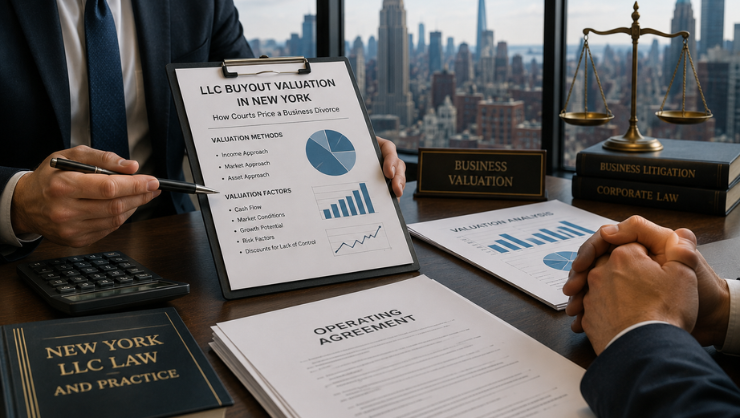
An LLC membership interest is valued using one or more of three standard appraisal approaches: the income approach, the market approach, and the asset approach. Which approach controls depends on the business, the available data, and what your operating agreement (if any) says about valuation standard and date.
The income approach projects future cash flows and discounts them to present value. It's the dominant method for profitable operating businesses — restaurants with multiple locations, established professional service firms, manufacturing operations. The market approach looks at comparable transactions or public-company multiples. It works well when there's a robust dataset of similar deals, less well for niche businesses. The asset approach values the company's underlying assets net of liabilities. It tends to control for real-estate-heavy LLCs and businesses that aren't generating meaningful cash flow.
Two preliminary questions usually swing the number more than the choice of approach. First, what's the standard of value? "Fair value" under New York case law is generally the member's pro rata share of the company as a going concern. "Fair market value" is what a willing buyer would pay a willing seller — which for a minority interest in a closely held LLC is much less. Second, what's the valuation date? In most LLC dissolution cases, courts use the day before the dissolution petition was filed. A six-month difference in valuation date can move the number by hundreds of thousands of dollars when revenue is volatile.
Then come the inputs. Reliable inputs require reliable books. LLCL § 1102 gives every member the right to inspect and copy specified records — articles of organization, operating agreement, tax returns for the three most recent years, and financial statements for the three most recent years — at the LLC's office during regular business hours, for any purpose reasonably related to the member's interest. If your managing member is stonewalling, a § 1102 demand followed by a verified petition is the first procedural move. We cover the broader fight pattern in what happens when your business partner won't play fair.
What discounts can reduce your LLC buyout price?
Two valuation discounts dominate New York buyout fights: the discount for lack of control (DLOC, sometimes called a minority discount) and the discount for lack of marketability (DLOM). Each can knock 10% to 35% off the gross enterprise value of your interest. Combined, they can cut a buyout price nearly in half.
The DLOC reflects that a minority interest can't force distributions, sales, or strategic decisions. The DLOM reflects that there's no public market for an interest in a closely held New York LLC — a buyer would demand a discount because the interest is hard to sell. The fight is whether either applies, and at what percentage.
New York courts have affirmed the application of significant marketability discounts — such as 35% — to a departing member's interest in dissolution and buyout proceedings. This principle is regularly invoked in LLC buyout cases by both sides — managing members argue it permits significant discounts; exiting members argue that cases involving wrongful dissociation present unique facts and should not translate to fair value proceedings.
The general New York rule for fair value proceedings under BCL § 1118 is that minority discounts (DLOC) are not applied — the exiting shareholder gets a pro rata share of going-concern value. Marketability discounts (DLOM) can apply but are scrutinized closely. LLC equitable buyouts borrow heavily from this corporate framework, but the law is less settled, and outcomes vary by department and judge. Experienced commercial litigators watch for which Commercial Division justice has been assigned because individual judges have markedly different track records on whether they'll apply a DLOM and at what percentage.
You should also expect arguments about normalizing adjustments to earnings. The managing member who controls payroll has often been paying themselves an above-market salary, running personal expenses through the company, or routing related-party transactions to entities they own. Those have to be added back before applying any income-approach multiple. Forensic accounting is where buyout cases are won or lost.
How should you prepare for an LLC buyout valuation fight?
You prepare for an LLC buyout valuation fight the same way you'd prepare for trial — by building the documentary record before you file. Once litigation starts, your counter-party will become much less cooperative, and the records you needed yesterday will get harder to obtain.
Start with what you can pull yourself: bank statements, tax returns, K-1s you've received over the life of the LLC, emails confirming distributions, capital contribution records, and any drafts of the operating agreement. If you're a non-managing member who's been frozen out, send a written § 1102 demand by certified mail naming the specific records you want. We've laid out the broader playbook for owners in this position in how minority LLC members can fight back against a freeze-out.
Engage a qualified business valuation expert early — ideally before you file. The expert can tell you whether your case is a $2M case or a $7M case, which affects every strategic decision: whether to file in the Commercial Division, whether to seek injunctive relief, whether to push for early mediation. The American Arbitration Association's Commercial Arbitration Rules are also worth reviewing if your operating agreement contains an arbitration clause, because the procedural framework for valuation in arbitration differs from court.
Consider provisional remedies. If you have evidence the managing member is dissipating assets, paying themselves excessive compensation, or transferring contracts to a competing entity, a preliminary injunction or prejudgment attachment can preserve the value of the interest you're trying to buy or sell. Our prior post on preliminary injunctions and TROs in New York walks through the standard.
Finally, read your operating agreement with fresh eyes. A surprising number include arbitration clauses, mandatory mediation provisions, valuation formulas, drag-along rights, or rights of first refusal that completely reshape the litigation. We discussed how operating agreements can affect dissolution rights in our post on whether your LLC operating agreement can block you from dissolving the business. The cheapest case is the one where you read your own contract before you sue.
Frequently Asked Questions
How long does an LLC buyout valuation case take in New York?
A contested LLC buyout valuation case in the Commercial Division typically takes 12 to 24 months from filing to disposition, with valuation discovery and expert depositions occupying the bulk of that time. Cases that settle after expert exchange but before trial often resolve in 9 to 15 months. Cases requiring full trial and post-trial briefing on valuation can stretch past 30 months.
Can I force my partner to buy me out of our New York LLC?
Not directly — there's no statutory buyout right for LLC members in New York the way there is for close corporation shareholders under BCL § 1118. What you can do is petition for judicial dissolution under LLCL § 702, and ask the court for an equitable buyout as alternative relief. In practice, a credible § 702 petition usually drives the parties to negotiate a buyout.
What standard of value applies to an LLC buyout in New York?
New York courts in LLC dissolution and equitable buyout cases generally apply "fair value," meaning the member's pro rata share of the company's going-concern value, not its liquidation value. Whether minority and marketability discounts apply remains contested and varies by court and fact pattern. The valuation date is typically set as of the day before the dissolution petition was filed.
Do I need an expert to win an LLC buyout valuation dispute?
Yes. Valuation is the central factual issue, and New York courts require expert testimony to support a fair value determination in any contested buyout. Going to court without a credentialed business valuation expert — typically someone with an ASA, ABV, or CVA designation — is malpractice-adjacent. The other side will have one, and the judge will weigh competing reports.
The Bottom Line
An LLC buyout valuation in New York hinges on three things: the standard of value, the valuation date, and the discounts. Get those right and the dollars usually follow. Get them wrong and you can leave seven figures on the table in a $5M business divorce.
If you or your business is facing an LLC buyout, partnership dissolution, or business divorce in New York, the team at Yassi Law PC is ready to help. Call us today at 646-992-2138 for a consultation.
This article is for informational purposes only and does not constitute legal advice. Although I am an attorney, I am not your attorney, and reading this article does not create an attorney-client relationship. Laws vary by jurisdiction and may have changed since the publication of this article. For advice specific to your situation, consult a qualified attorney.

.png)