
New York's 'Visible Intoxication' Standard Under GOL § 11-101: What Dram Shop Plaintiffs Must Prove in Brain Injury Cases Against Bars

Updated: 24 hours ago
Updated October 21, 2026
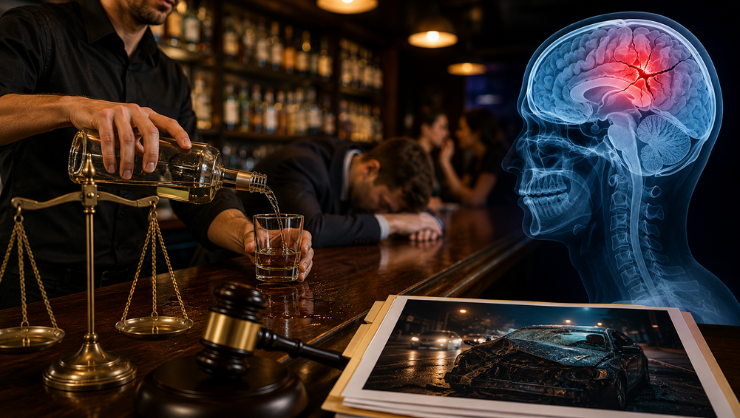
You're driving home along the Long Island Expressway after a late shift. A pickup truck blows a red light at 70 mph and T-bones your sedan. The driver reeks of alcohol. He just left a bar in Mineola where the bartender kept pouring shots for two hours after he was slurring his words. Your husband suffers a traumatic brain injury that ends his career and changes your family forever. The drunk driver carries a $25,000 auto policy. The bar carries $1 million in liquor liability coverage, which is why the bar's role in the crash matters so much.
This is the world of New York's dram shop law. The doctrine of dram shop liability lets you sue the bar, restaurant, club, or liquor store that sold alcohol to the drunk driver who hurt you. But the case rises or falls on one short phrase buried in the statute: visible intoxication. If you can't prove the bar served someone who was visibly drunk, you don't have a dram shop case in New York, no matter how high the driver's blood alcohol level turned out to be.
This post walks you through how the Court of Appeals and the Appellate Divisions actually apply the visible intoxication standard, why surveillance footage and bartender depositions are the battleground, when punitive damages enter the picture, and what families need to lock down in the first 72 hours after a catastrophic drunk driving crash to keep their dram shop claim alive.
Key takeaways
In New York, a bar is liable under the dram shop law only if it served someone who was visibly intoxicated.
A high blood alcohol reading alone does not prove visible intoxication; courts look for evidence of how the person looked and acted.
Bar surveillance systems often record over footage within weeks, so preservation letters should go out within days of the crash.
Police reports, receipts, witness accounts and bartender testimony all help show what the driver looked like when he was served.
Dram shop claims generally must be filed within three years, and wrongful death deadlines are different and shorter.
What Is Dram Shop Liability Under New York's General Obligations Law § 11-101?
Dram shop liability is a statutory cause of action that lets a person injured by a drunk customer sue the establishment that illegally served that customer. The rule lives in General Obligations Law § 11-101, which gives anyone injured "in person, property, means of support, or otherwise" by an intoxicated person a right of action against whoever "unlawfully" sold or assisted in procuring the alcohol that caused or contributed to that intoxication.
The companion statute is Alcoholic Beverage Control Law § 65, which makes it unlawful to sell alcohol to three categories of people: anyone under 21, anyone visibly intoxicated, and any habitual drunkard known to be one. For dram shop cases involving adult drunk drivers, the second category does the heavy lifting. The bar broke the law by serving a visibly intoxicated patron. GOL § 11-101 then converts that unlawful sale into civil liability for the injuries that followed.
Two features of the statute matter enormously for catastrophic injury victims. First, the dram shop act is not limited to bars. It reaches restaurants, hotel lounges, catering halls, nightclubs, package stores, and even social hosts in narrow circumstances under GOL § 11-100 (the companion statute for unlawful service to minors). Second, the statute itself authorizes "actual and exemplary damages." That phrase, exemplary damages, is the statutory hook for punitive damages, and it changes settlement dynamics in ways we'll cover below.
Dram shop claims must generally be filed within three years under CPLR § 214(2), because they are liabilities "created or imposed by statute." If a death results, the survivors' claim runs under wrongful death and survival statutes on shorter timelines, so early investigation is essential. Our post on conscious pain and suffering in New York wrongful death cases explains how those parallel claims work alongside a dram shop count.
What Does 'Visible Intoxication' Actually Mean in New York Courts?
Visible intoxication means outward signs of drunkenness that a reasonable bartender or server would observe, not just a high blood alcohol level after the fact. New York's appellate courts have been emphatic on this point. A toxicologist's testimony that the driver "must have been" intoxicated based on later BAC readings is not enough by itself.
The Court of Appeals laid down the foundation in Romano v. Stanley, 90 N.Y.2d 444 (1997). The court held that visible intoxication can be proved with circumstantial evidence, not only eyewitness testimony, but that a high blood alcohol count alone does not establish it. As the court put it, "Thus, even where it can be established, a high blood alcohol count in the person served may not provide a sound basis for drawing inferences about the individual’s appearance or demeanor." Because the plaintiffs' expert affidavit in that case was speculative and conclusory, the bars were granted summary judgment.
A year later, the same court showed how circumstantial proof can work in Adamy v. Ziriakus, 92 N.Y.2d 396 (1998). No witness from the bar testified that the driver showed signs of intoxication there. Instead, the plaintiff offered three things. The first was a forensic pathologist's opinion based on the driver's later BAC. The second was testimony from police officers who saw him at the crash scene shortly after he left the bar, describing alcohol on his breath, glassy and bloodshot eyes, slurred speech, and swaying or staggering. The third was an inference from the bar's failure to call the bartender who was on duty that night. The Court of Appeals let the jury's verdict against the bar stand, explaining: "Given that these observations occurred a short time after Ziriakus left Friday’s, it was not irrational for the jury, based on everyday experience and common knowledge, to find that Ziriakus was visibly intoxicated when served at Friday’s." The lesson from Romano and Adamy read together is simple: BAC numbers are corroboration, but the case needs evidence of how the patron actually looked and acted, close in time to when the bar served him.
The four Appellate Divisions have built on that framework. They've allowed dram shop cases to reach a jury where the plaintiff produced bar tabs showing many drinks served over a short period, server statements about the patron's condition, photos or video showing the patron stumbling, and lay witness testimony from other customers. They've thrown out cases where the only "proof" was the post-crash BAC.
A more recent example shows how much the bar's own proof matters when it asks a court to dismiss the case early. In Denenberg v. 268 W. 47th Rest., Inc., 211 A.D.3d 404 (1st Dep't 2022), the First Department refused to throw out a dram shop claim against a nightclub. The driver's own testimony was equivocal and given while he was intoxicated, and the club offered no testimony from its staff based on personal knowledge. The court held that the driver's testimony "was insufficient to rule out the possibility that he was served alcohol by Copacabana waitstaff while he was visibly intoxicated."
What counts as "visible" signs? Courts have credited slurred or thick speech, bloodshot or glassy eyes, an unsteady gait, swaying on a barstool, loud or belligerent behavior, flushed face, the odor of alcohol on the breath, difficulty handling money or making change, and falling asleep at the bar. No single sign is required, and no precise combination is dispositive. The question is whether a reasonable observer would have seen the patron as drunk.
How Do Surveillance Video and Bartender Testimony Decide These Cases?
Surveillance video and bartender testimony are the evidentiary battleground in modern dram shop cases because they are the only contemporaneous record of what the patron looked like at the bar. Almost every commercial establishment in New York now runs digital camera systems. Footage typically captures the bar area, the front door, the parking lot, and sometimes the dining room. That footage either confirms the patron was wobbling and slurring — or it doesn't.
The problem is that most surveillance systems overwrite themselves on a 7, 14, or 30-day loop. If your lawyer doesn't send a litigation hold letter immediately, the footage is gone forever. A preservation letter sent on day three is a different animal from one sent on day forty. By day forty, the bar's lawyer will respond truthfully that the footage no longer exists, and a spoliation motion is far harder to support when the destruction happened in the ordinary course before any duty to preserve crystallized. Personal injury counsel should send written preservation demands to the establishment, its insurer, and the alarm/video vendor within days of the crash.
Bartender and server depositions are the other front. Servers know that admitting they kept pouring for a visibly drunk customer can cost the bar its liquor license and expose them personally to discipline. Their natural instinct at deposition is to remember nothing, to insist they cut the patron off, or to claim the patron showed no signs. Cross-examination with the surveillance video, credit card receipts showing the number and timing of drinks, and prior statements to police can corner the witness. The drinks-served data matters because a 180-pound man who consumes eight drinks in two hours is, as a matter of pharmacology, going to be visibly impaired — and a jury can be walked through that math.
Police reports from the scene also matter. The arresting officer will document the driver's appearance (slurred speech, odor of alcohol, failed field sobriety tests) and the driver's own statements about where he had been drinking. Bar receipts in the driver's wallet, GPS data on his phone, and Uber or rideshare records can establish the chain from bar to crash. Because dram shop cases so often turn on a defense motion to dismiss the claim before trial, our explanation of summary judgment under CPLR § 3212 is worth reading to understand exactly what the plaintiff must put in the record to defeat that motion.
A caution about the driver's own words: in Sherwood v. Otto Jazz, Inc., 186 A.D.3d 891 (2d Dep't 2020), the Second Department reversed a jury verdict against a bar and dismissed the complaint. The driver's plea allocution could not be used against the bar, and without it there was no evidence the bar served him while he was visibly intoxicated. As the court put it, "Here, viewing the evidence in the light most favorable to the plaintiff, no rational jury could have found at the close of the plaintiff's case that Otto served alcohol to Coyle while he was visibly intoxicated." Proof about the moment of service needs to come from evidence that can actually be used against the bar.
The drunk driver's medical records carry weight too. Hospital intake notes from Nassau University Medical Center or Stony Brook will document the patient's mental status, smell of alcohol, and any spontaneous admissions about how much he drank. Traumatic brain injuries are a leading cause of death and lifelong disability in the United States, and drunk driving is one of the most common mechanisms. Documenting the link between the bar's service and the resulting TBI is the heart of the case — and our deep dive on day-in-the-life videos in catastrophic injury cases explains how the damages side of that picture gets built.
Can You Recover Punitive Damages in a New York Dram Shop Case?
Yes — GOL § 11-101 explicitly authorizes "exemplary damages," which is the older term for punitive damages. That makes dram shop one of a small handful of New York causes of action where punitive damages are written into the statute itself, rather than being available only under common-law standards.
That doesn't mean punitive damages are automatic. New York courts require that the bar's conduct rise above ordinary negligence and approach willful or reckless disregard for the safety of others. Service of one or two extra drinks, in isolation, will typically not support a punitive award. But a pattern of over-service to a patron who is staggering, falling off his stool, or being physically supported by friends, and who is then handed his car keys by the same establishment, is a different story.
Punitive damages matter strategically even before trial. Most general liability insurance policies in New York do not cover punitive damages, which means the bar's owners are personally exposed for that portion of any verdict. That personal exposure tends to move settlement negotiations. Defense lawyers who would otherwise dig in on a borderline visible intoxication case will recommend serious settlement discussions once it becomes clear the plaintiff can build a credible punitive damages theory. Alcohol-impaired driving causes a substantial number of fatalities each year nationally and in New York. Juries hear about that toll, and they respond to evidence that a bar prioritized a $40 bar tab over a human life.
Damages in a catastrophic TBI dram shop case routinely include past and future medical expenses, lost earnings and lost earning capacity, life-care planning costs (nursing, therapy, equipment, home modifications), past and future pain and suffering, and loss of consortium for the spouse. For a 45-year-old union electrician earning $120,000 per year who is left with permanent cognitive deficits, the economic damages claim covers decades of lost earnings and lifetime care costs, separate from any award for pain and suffering. Lifetime medical costs for severe TBI are substantial, and published estimates typically understate real-world expenses in the New York metro area.
What Should Victims and Families Do in the First 72 Hours After a Drunk Driving Crash?
The first 72 hours after a catastrophic drunk driving crash are often when the evidence a dram shop case depends on is either preserved or lost. Evidence disappears quickly, and the bar's lawyers will be working their phones long before yours.
Here is the short list of what needs to happen — and these are the things experienced injury counsel will start within days of being retained:
Send written preservation-of-evidence letters to the bar, its insurer, its alarm/video vendor, and any third-party POS system provider, demanding retention of all surveillance footage, drink-by-drink point-of-sale data, time-stamped credit card receipts, and server schedules.
Obtain the certified police report, the driver's arrest paperwork, BAC test results, and any body-cam or dash-cam footage from the responding agency.
Identify and interview eyewitnesses (other patrons, the cab driver who refused the fare, the parking attendant who saw the patron stumble) before memories fade and contact information goes stale.
Pull cell phone, Uber/Lyft, and credit card records to map where the driver drank and how long he was at each location.
Beyond evidence, families need to focus on the catastrophically injured loved one's care. Coordinate with the hospital's social work team to begin discharge planning early, especially if the patient will need long-term rehab at a facility like Burke Rehabilitation in White Plains, Helen Hayes Hospital, or Mount Sinai's TBI program. Document everything: photos of injuries, daily journals of symptoms, lists of every medication and therapy. This documentation becomes the foundation for the life-care plan that drives damages.
In our practice, the biggest mistake we see is waiting to get medical treatment. The longer the gap between the accident and your first visit, the harder it is to prove the accident caused your injuries, and the less believable the claim becomes to an insurer or a jury.
One often-overlooked issue: if the drunk driver was working at the time of the crash (delivery driver, salesperson on a business trip, ride-share contractor), there may be additional defendants — the employer under respondeat superior, the franchise, or the platform. And if the at-fault driver is a New Jersey resident or the bar is across state lines, jurisdictional questions get complicated. The Supreme Court's recent decision discussed in our post on Galette v. NJ Transit and out-of-state defendants in New York illustrates how courts now treat cross-border claims. Cases involving construction workers injured by drunk drivers can also implicate workplace coverage rules described in our analysis of the First Department's grave injury standard under WCL § 11.
Frequently Asked Questions
Does a high blood alcohol level alone prove visible intoxication in New York?
No. New York's Court of Appeals has held that a post-crash BAC reading by itself is not enough to defeat summary judgment on the visible intoxication element. You need eyewitness or video evidence of the patron's actual appearance and conduct at the bar, with the BAC serving as corroboration rather than the sole proof.
Can I sue a private party who served alcohol at a house party in Long Island?
Generally no, with one major exception. Social hosts in New York are not liable to third parties for serving alcohol to visibly intoxicated adults. But GOL § 11-100 does impose liability on anyone, including social hosts, who knowingly provides or assists in providing alcohol to someone under 21 who then injures another person.
How long do I have to file a dram shop case in New York?
You typically have three years from the date of injury under CPLR § 214(2), because dram shop is a statutorily-created liability. If your loved one died, wrongful death and survival deadlines are different and shorter, and notice-of-claim deadlines may apply if a public entity is involved. Don't rely on the three-year period without first speaking to counsel about the specific facts.
What if the bar claims it didn't know the customer was drunk?
The legal standard is objective, not subjective. The question isn't whether the bartender personally noticed signs of intoxication — it's whether a reasonable server, observing the patron's appearance and conduct, would have recognized visible intoxication. A bar can't escape liability by hiring bartenders who claim they didn't notice the obvious.
The Bottom Line for Catastrophic Injury Victims
New York's dram shop statute remains one of the most powerful tools for catastrophically injured victims of drunk drivers — but only when the visible intoxication element is proven with on-the-scene evidence. Surveillance footage, server testimony, drink counts, and eyewitness statements decide these cases long before a jury is ever seated. The cases that fail are the ones where nobody preserved the evidence in time.
If you or a loved one has suffered a traumatic brain injury or other catastrophic harm because a New York bar over-served the driver who caused the crash, the team at Yassi Law PC is ready to help. Call us today at 646-992-2138 for a consultation.
This article is for informational purposes only and does not constitute legal advice. Although I am an attorney, I am not your attorney, and reading this article does not create an attorney-client relationship. Laws vary by jurisdiction and may have changed since the publication of this article. For advice specific to your situation, consult a qualified attorney.

.png)