
Prior Written Notice in Nassau County: Why a Cyclist's Skull Fracture Case Against a Long Island Village Can Die Before It Starts

Updated: Sep 25
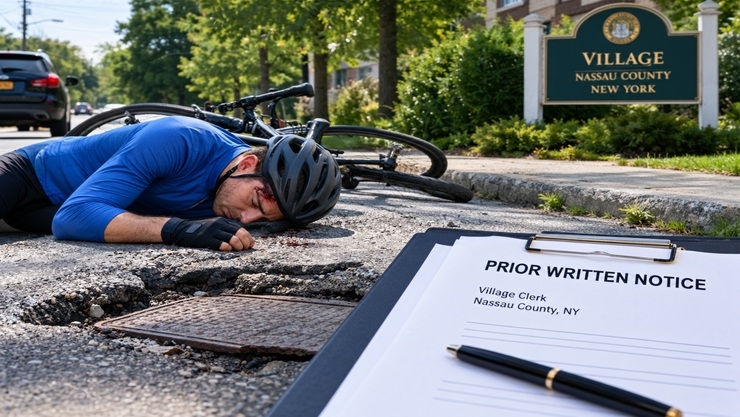
You're on a Sunday morning ride through a quiet village in Nassau County — maybe Freeport, Mineola, or Sea Cliff. Your front wheel drops into a sunken utility cut that's been deteriorating for months, and you go over the handlebars headfirst. Your helmet cracks. At the hospital, the diagnosis is a depressed skull fracture with bleeding on the brain. Then, weeks later, the village attorney says two words that can end your case before it starts: prior written notice. If nobody sent the village a written complaint about that exact defect before your crash, the law may bar your claim entirely — no matter how obvious the hazard was.
What Is Prior Written Notice, and Why Can It End a Nassau County Road Defect Case Before Discovery Begins?
Prior written notice is a legal precondition: before you can sue most Long Island villages and towns for a defective road, sidewalk, or crosswalk, someone must have given the municipality written notice of that specific defect before your accident — and the municipality must have failed to fix it within a reasonable time. It's not about what the village knew or should have known. It's about a piece of paper.
For villages, the default rule comes from Village Law § 6-628, which bars injury lawsuits based on defective streets, highways, bridges, culverts, sidewalks, or crosswalks unless written notice of the defect was actually given to the village clerk and the village failed to repair it within a reasonable time afterward. For towns, Town Law § 65-a imposes a similar rule for defective town highways, bridges, and culverts, requiring written notice to the town clerk or the town superintendent of highways.
Here's what makes this rule so brutal. In an ordinary negligence case, you can win by proving the defendant had "constructive notice" — meaning the hazard existed long enough that a reasonable property owner should have discovered it. Prior written notice statutes wipe that out. The Court of Appeals confirmed in Amabile v. City of Buffalo that neither constructive notice nor actual verbal knowledge substitutes for the written notice the statute demands. A pothole photographed by residents for two years, complained about at village board meetings, and driven around by every local — none of that matters if no written complaint reached the right official.
We've seen this same trap end serious cases before. Our earlier post on how Nassau's town and village road defect laws can kill a catastrophic motorcycle crash case walks through the same doctrine from a rider's perspective. For cyclists, the stakes are arguably higher, because a cyclist has no steel cage, and head trauma is often the injury that results.
Which Nassau County Towns and Villages Require Prior Written Notice — and Who Must Receive It?
Nearly all of them. Nassau County is a patchwork: three towns (Hempstead, North Hempstead, and Oyster Bay), two cities (Glen Cove and Long Beach), and more than 60 incorporated villages, each with its own government, its own roads, and in most cases its own prior-written-notice provision layered on top of the state statutes. Nassau County itself also maintains a prior-written-notice requirement for county roads under its own administrative code. So the first question in any roadway defect case on Long Island isn't "how bad was the pothole" — it's "whose road is this, and what does that entity's notice law say?"
That question matters because notice must go to the specific official designated in the statute. Under Village Law § 6-628, that's the village clerk. Under Town Law § 65-a, it's the town clerk or the highway superintendent. In Gorman v. Town of Huntington, New York's highest court held that written notice delivered to the wrong municipal department doesn't satisfy the statute, even if the town's road crews clearly learned about the problem. A resident's letter to the parks department or the mayor's office may accomplish nothing legally.
There's a limit on how far municipalities can stretch these laws, though. In Walker v. Town of Hempstead, the Court of Appeals held that local prior-written-notice laws can only apply to the six location categories authorized by state law — streets, highways, bridges, culverts, sidewalks, and crosswalks. That matters enormously for cyclists. If you were hurt on a surface that doesn't fit those six categories — a recreational facility inside a park, for example — the prior-written-notice defense may not apply at all, and the case proceeds on ordinary negligence principles. One caution: courts interpret these categories by function, not by label. A municipal parking lot, for instance, has been treated as a "highway" for prior-written-notice purposes, so whether a given surface falls inside or outside the six categories is an analysis that requires real care, not a quick assumption.
Whichever entity owns the road, the clock is unforgiving. These deadlines run alongside the notice question:
90 days from the accident to serve a notice of claim under General Municipal Law § 50-e
One year and 90 days to file the lawsuit itself under General Municipal Law § 50-i
Before the crash — the written notice of the defect must already have existed; nothing you file afterward creates it
We've covered the 90-day deadline in depth in our post on how GML § 50-e can kill a catastrophic injury case against a municipality. Miss it, and you may never get to argue about prior written notice at all.
How Do You Use FOIL Requests to Find the Written Notice a Village Swears It Never Received?
You use New York's Freedom of Information Law to force the municipality to open its own files — because the proof that saves your case usually sits in a filing cabinet at village hall. Under Public Officers Law § 87, government agencies must make their records available for inspection and copying, subject to limited exemptions. And here's a detail buried in Village Law § 6-628 itself: the village clerk is required to keep an indexed record of all written notices of defects the village receives. That indexed record is a roadmap. If a resident, a letter carrier, an insurance company, or a utility contractor sent a written complaint about your defect eighteen months ago, it should be logged there.
A thorough FOIL hunt in a skull fracture case typically demands:
The clerk's indexed record of written defect notices for the road segment, going back several years
Complaint logs, correspondence, and constituent letters mentioning the location
Work orders, repair records, and inspection reports for the roadway
Street-opening permits and utility contracts showing who cut into the pavement and when
Board meeting minutes and highway department memos referencing the defect
Agencies generally must acknowledge a FOIL request within five business days, and denials can be appealed. Our guide on using FOIL requests to strengthen a New York personal injury case explains the mechanics step by step.
Experienced lawyers watch for something counterintuitive here: even when the FOIL response confirms that no written notice exists, the same records can rescue the case, because a work order showing the village's own crew paved over that utility cut shortly before your crash converts a dead prior-written-notice case into an affirmative-negligence case. Most claimants miss that a complaint typed into a village's online citizen-request portal or a 311-style app may not qualify as written notice at all if it never reached the clerk or other official the statute designates — which is exactly why the paper hunt has to go deeper than "did anyone complain."
What Exceptions Beat Prior Written Notice in a Catastrophic Cycling Case?
New York recognizes two exceptions that let a case survive even when no written notice exists: affirmative negligence and special use. The Court of Appeals confirmed both in Amabile v. City of Buffalo, and they're often the only path forward in a serious Nassau County road defect case.
Affirmative negligence applies when the municipality itself created the dangerous condition through an affirmative act — a road crew that milled the pavement and left an unmarked drop-off, a botched pothole patch that left a raised lip, a trench that was backfilled improperly. The catch, under Yarborough v. City of New York, is immediacy: the defect must have resulted immediately from the municipality's work, not developed gradually over time through wear and weather. A patch that was dangerous the day the crew drove away fits the exception. A patch that slowly eroded over three winters usually doesn't.
Special use applies when the municipality derived a special benefit from the portion of roadway where the defect sat — think of a drainage structure or an access installation serving a municipal facility. It's a narrower doctrine, but in the right facts it removes the notice requirement entirely.
Appellate courts across the state continue to shape how these exceptions get applied, and the trend matters for anyone with a pending roadway case. We tracked recent decisions in our post on how the prior written notice exception is saving New York roadway defect claims. The practical takeaway: the exceptions are proven with documents — street-opening permits, contractor agreements, resurfacing records — which is why the FOIL work described above isn't optional. It's the case.
What Are Future Neurosurgical Care and Cognitive Rehabilitation Worth in a Skull Fracture Case?
In a serious skull fracture case, future medical care and cognitive rehabilitation are usually the largest components of damages — often larger than everything the injured cyclist has already been through. A depressed or basilar skull fracture frequently comes with an underlying traumatic brain injury: an epidural or subdural hematoma requiring emergency craniotomy, followed by risks of seizures, hydrocephalus requiring shunt placement and periodic revision, cranioplasty to repair the skull, and years of neurology follow-up. According to the CDC, traumatic brain injury is a major cause of death and long-term disability in the United States, and brain injury is best understood as a chronic condition requiring ongoing management, not a one-time event.
Cyclists bear a disproportionate share of this harm. NHTSA reports that a significant number of bicyclists are killed in U.S. traffic crashes in a typical recent year, and IIHS fatality data show bicyclist deaths have trended upward over the past decade. Head injury is the reason so many of these crashes turn catastrophic, and the same is true when the cause is a roadway defect rather than a driver. We wrote about the human cost of cycling trauma in our post on the death of a delivery cyclist in Harlem.
Proving these damages takes a team. A life care planner projects every future need — neurosurgical follow-up, imaging, medication, neuropsychological re-evaluation, cognitive rehabilitation therapy, speech-language therapy, and vocational retraining — and an economist reduces those needs to present-value numbers. Cognitive rehab alone can mean multiple sessions per week for years, and in a case involving permanent cognitive deficits, credible life care plans routinely reach seven figures before lost earnings are even added.
Venue matters here too. Nassau County juries have a reputation for scrutinizing pain-and-suffering claims more skeptically than juries in the Bronx or Brooklyn, but they tend to respect hard, well-documented economic numbers presented by credible experts. We explored those tendencies in our post on Nassau County venue strategy for surgical error cases, and the same logic applies to a roadway defect trial in Mineola: the stronger and more specific the future-care proof, the better the case performs in front of a Long Island jury.
Frequently Asked Questions
Does a 311 call or online complaint count as prior written notice in Nassau County?
Often not. The written notice generally must reach the specific official designated by statute — the village clerk under Village Law § 6-628, or the town clerk or highway superintendent under Town Law § 65-a. A phone call, verbal complaint, or portal submission routed to a different department may not satisfy the statute, which is why an attorney investigates exactly what was sent, to whom, and when.
How long do I have to sue a Nassau County village for a road defect injury?
You generally must serve a notice of claim within 90 days of the accident under General Municipal Law § 50-e, and file the lawsuit within one year and 90 days under § 50-i. These deadlines are separate from the prior-written-notice requirement, which concerns notice of the defect given before your crash.
Can I still win my case if no one ever gave the village written notice of the pothole?
Possibly. New York recognizes two exceptions: affirmative negligence, where the municipality created the defect through its own work, and special use, where it derived a special benefit from the roadway area. Both are proven with records like work orders and street-opening permits, which is why early FOIL requests are critical.
Does prior written notice apply if I crashed on a bike path in a park?
Maybe not. Under the Court of Appeals' decision in Walker v. Town of Hempstead, prior-written-notice laws can only cover six categories: streets, highways, bridges, culverts, sidewalks, and crosswalks. A defect on a park path, parking lot, or other surface outside those categories may be judged under ordinary negligence rules instead.
Conclusion
Prior written notice is the single biggest threat to a cyclist's roadway defect case in Nassau County, and it has to be attacked immediately — through fast FOIL requests, careful identification of the responsible municipality, and early development of the affirmative-negligence and special-use exceptions. A skull fracture case with seven figures in future neurosurgical and cognitive rehabilitation needs deserves that urgency from day one.
If you or someone you know suffered a skull fracture or another catastrophic injury because of a dangerous road, pothole, or pavement defect in Nassau County, the team at Yassi Law PC is ready to help. Call us today at 646-992-2138 for a consultation.
Written by Reza Yassi
This article is for informational purposes only and does not constitute legal advice. Although I am an attorney, I am not your attorney, and reading this article does not create an attorney-client relationship. Laws vary by jurisdiction and may have changed since the publication of this article. For advice specific to your situation, consult a qualified attorney.

.png)