
Bazdaric v. Almah Partners: How a 2024 Court of Appeals Ruling Expanded Labor Law § 241(6) Slipping-Hazard Claims for Injured Construction Workers

Updated: Aug 24
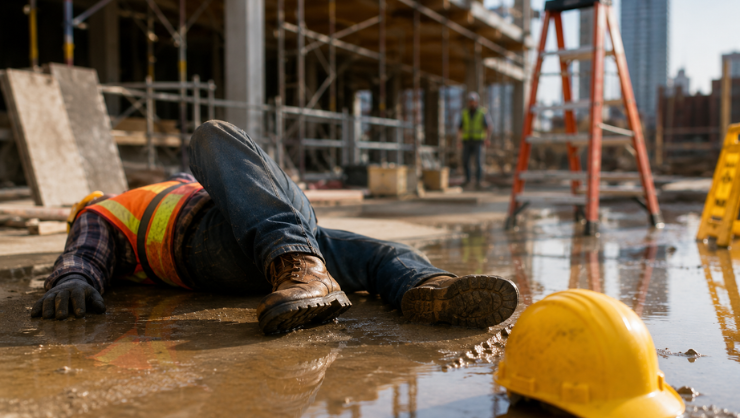
Picture a gut renovation in the Bronx. You're a painter working over a stairwell, and the contractor has taped slick plastic sheeting over every step to protect the finish. One foot slides, and in half a second you're at the bottom with a shattered kneecap and a hip that needs plates and screws. For decades, defense lawyers argued that a covering like that wasn't a "slipping hazard" under New York law. In 2024, the Court of Appeals disagreed — and in doing so, it strengthened Labor Law § 241(6) claims for construction workers hurt in exactly this kind of fall.
What Did the Court of Appeals Decide in Bazdaric v. Almah Partners?
In Bazdaric v. Almah Partners LLC, 41 NY3d 310 (2024), New York's highest court held that a plastic covering placed over an escalator qualified as a "foreign substance" under Industrial Code section 23-1.7(d) — the rule that bans slippery working surfaces on construction sites. That single holding opened the door for workers who slip on protective coverings, sheeting, and other slick materials to bring Labor Law § 241(6) claims that lower courts had been throwing out.
The facts were simple. The plaintiff was a painter assigned to paint above a stopped escalator in an office building. The steps of the escalator had been draped in plastic to protect them from paint. He slipped on the plastic, fell, and was seriously hurt.
The Appellate Division had dismissed his claim, reasoning that a plastic covering wasn't like the ice, snow, water, or grease listed in the regulation. On February 20, 2024, the Court of Appeals reversed. The Court explained that the regulation's list of substances is illustrative, not exhaustive. A "foreign substance" is anything that isn't part of the working surface itself and that creates slippery footing. Plastic sheeting laid over escalator steps fit that definition perfectly.
Just as important, the Court rejected the defense argument that the covering was "integral to the work" and therefore immune from liability. More on that defense below, because it's where most of these cases are now won or lost.
What Is Labor Law § 241(6) and How Does It Protect Construction Workers?
Under Labor Law § 241, areas where construction, excavation, or demolition work is being performed must be constructed, equipped, and operated to provide reasonable and adequate protection for workers, in line with the safety rules issued by the state. Subdivision (6) is the piece injured workers rely on. It places a nondelegable duty on property owners and general contractors — meaning they can't escape responsibility by pointing the finger at a subcontractor who actually created the hazard.
There's a catch, though. To win a Labor Law § 241(6) claim, you can't just say the site was unsafe in a general way. You have to identify a specific, concrete provision of the New York Industrial Code that was violated. The Court of Appeals made that clear in Ross v. Curtis-Palmer Hydro-Electric Co., 81 NY2d 494 (1993), and it remains the rule today.
That's why individual Industrial Code sections matter so much. A rule about eye protection can drive an entire case, as we explained in our post on grinder and power tool eye injuries under Industrial Code 23-1.8. A rule about shoring can decide a fatal cave-in case, as we covered in our post on trench collapse claims under Industrial Code 23-4.2. For slipping falls, the key provision is 23-1.7(d) — and Bazdaric just made it considerably more powerful.
Unlike the Scaffold Law, which covers gravity-related accidents like the ones we discussed in our analysis of Altamirano v. Frick Collection, a Labor Law § 241(6) claim allows the defense to argue comparative fault. Your own carelessness can reduce your recovery — but it doesn't bar it. If a jury finds you 20% at fault, you still recover 80% of your damages.
What Counts as a "Foreign Substance" Under Industrial Code 23-1.7(d) After Bazdaric?
After Bazdaric, a foreign substance is any slippery material that isn't a natural, built-in part of the floor, passageway, platform, or other surface you're working on. Industrial Code section 23-1.7(d) — found at 12 NYCRR 23-1.7(d) — prohibits employers from allowing workers to use a floor, passageway, walkway, scaffold, platform, or other elevated working surface that's in a slippery condition, and it requires that ice, snow, water, grease, "and any other foreign substance" causing slippery footing be removed, sanded, or covered.
Before 2024, many trial courts read that list narrowly. If you slipped on plastic sheeting, rosin paper, or a slick protective covering, defendants argued the rule didn't apply because a covering isn't a "substance" like grease or ice. Some judges agreed, and legitimate cases died early.
Bazdaric changed the analysis. The Court held that the listed examples simply illustrate the kinds of hazards the rule targets. What matters is function, not chemistry: does the material create slippery footing, and is it foreign to the surface itself? Under that reading, workers hurt in a construction site fall now have a viable claim when they slip on things like:
Plastic sheeting or poly coverings taped over stairs, escalators, or ramps
Protective paper or board laid over finished floors during renovation
Spilled paint, primer, or floor-leveling compound left on a walkway
Oil or hydraulic fluid tracked across a passageway
One limit survives: the rule doesn't apply to a surface that is slippery by its inherent nature and design. A smooth new tile floor, standing alone, isn't a foreign substance. The hazard has to come from something added to the surface. That distinction is where the factual fight usually lives, and it's why early photographs of the actual covering or spill are so valuable.
How Does the "Integral to the Work" Defense Change After Bazdaric?
After Bazdaric, the "integral to the work" defense is much harder for owners and contractors to use in slipping cases. The defense works like this: if the condition that hurt you was a necessary part of the very work being performed — say, you tripped over demolition debris you were hired to remove — courts have held the Industrial Code wasn't violated. In Bazdaric, the defendants argued the plastic covering was integral to the paint job because it protected the escalator from drips.
The Court of Appeals rejected that argument, and its reasoning matters for every future case. The question isn't whether covering the escalator was part of the job. The question is whether the specific hazard — a slippery plastic covering — was necessary, when safer alternatives like non-slip drop cloths could have done the same job without creating slippery footing. Protecting the steps was integral. Using a dangerous material to do it was not.
Experienced lawyers watch for defendants pleading "integral to the work" reflexively in every answer, because after Bazdaric the defense can often be beaten by proving through a site-safety expert that a non-slip alternative was standard, cheap, and available — a line of attack many injured workers and even some attorneys never develop. Building that record early, before the covering is thrown in a dumpster and the crew scatters to other jobs, can be the difference between a dismissed case and a seven-figure recovery for a worker facing fusion surgery and a career that's over at 45.
This ruling fits a broader pattern. As we noted in our review of NYC construction accident trends in 2026, New York's appellate courts have repeatedly read worker-protection statutes in favor of coverage over the last several years. Bazdaric is one of the clearest examples.
What Should You Do After a Slipping Fall on a New York Construction Site?
Get medical care first, then move fast to preserve evidence, because slippery coverings are usually gone within days. According to OSHA, falls are the leading cause of death in construction, and falls, slips, and trips consistently account for a substantial share of construction fatalities nationwide. The non-fatal falls are devastating too: shattered wrists, tibial plateau fractures, torn shoulders, and hips rebuilt with hardware — injuries that can end a union career and require multiple surgeries over a decade.
If you can, or if a coworker can do it for you, photograph the covering or spill exactly as it was, get the names and numbers of everyone who saw the fall or saw the condition beforehand, and make sure the accident is written up in the site log. Don't give a recorded statement to any insurance company before you've spoken with a lawyer.
Understand the two tracks your case will run on. Workers' compensation pays a portion of your lost wages — generally two-thirds of your average weekly wage, subject to a cap — and your medical bills, regardless of fault. But comp pays nothing for pain and suffering. A third-party lawsuit against the owner and general contractor under Labor Law § 241(6) is where full compensation lives: pain and suffering, the full gap in your lost earnings, future medical care, and loss of enjoyment of life. Most injured workers miss that the comp carrier will assert a lien on the lawsuit recovery, which is one more reason the third-party case needs to be handled by someone who negotiates those liens down as part of the settlement.
Watch your deadlines. Under CPLR § 214, a personal injury lawsuit must generally be filed within three years of the accident. If a public entity owns the site, much shorter notice deadlines can apply, so don't sit on your rights. And as we explained in our post on why NYC construction accidents keep claiming lives in 2026, the workers hurt on smaller, non-union renovation jobs — the kind happening right now across the Bronx, Staten Island, and Suffolk County — are often the ones who most need these protections and know the least about them.
Frequently Asked Questions
Does Labor Law § 241(6) apply if I was partly at fault for my fall?
Yes. Unlike some other Labor Law claims, comparative fault applies to a 241(6) claim, but it only reduces your recovery — it doesn't eliminate it. If you're found 25% responsible, you still recover 75% of your damages from the owner and general contractor.
Can I sue my own employer for a construction site fall?
Generally no. Workers' compensation is usually your only remedy against your direct employer. But Labor Law § 241(6) lets you sue the property owner and the general contractor, who owe you a nondelegable safety duty even if they never set foot on the site.
What if the plastic covering was removed right after my accident?
Your case isn't over. Photographs, witness testimony, accident reports, and daily site logs can all establish what the surface looked like. A lawyer can also send preservation letters immediately, and if a defendant destroys evidence after being told to keep it, courts can penalize them at trial.
How long do I have to file a Labor Law § 241(6) lawsuit in New York?
Generally three years from the date of the accident under CPLR § 214. If a city, state, or public authority owns the property, much shorter notice requirements can apply — sometimes measured in months, not years — so speak with a lawyer as soon as possible.
Talk to a New York Construction Accident Lawyer
Bazdaric v. Almah Partners confirmed that a slippery covering is just as much a violation as a patch of ice, and it stripped away the defense that dangerous materials are excusable just because they served the job. If you slipped on plastic, paper, or any slick material at a New York construction site, you likely have a stronger claim today than you would have had before 2024.
Written by Reza Yassi
If you or someone you know suffered a serious fall on a New York construction site, the team at Yassi Law P.C. is ready to help. Call us today at 646-992-2138 for a consultation.
This article is for informational purposes only and does not constitute legal advice. Although I am an attorney, I am not your attorney, and reading this article does not create an attorney-client relationship. Laws vary by jurisdiction and may have changed since the publication of this article. For advice specific to your situation, consult a qualified attorney.

.png)