
Comparative Fault in New York Won't Kill Your Case: How CPLR § 1411 Lets a Partially At-Fault Motorcyclist Recover Millions for a Leg Amputation

Updated: Sep 23
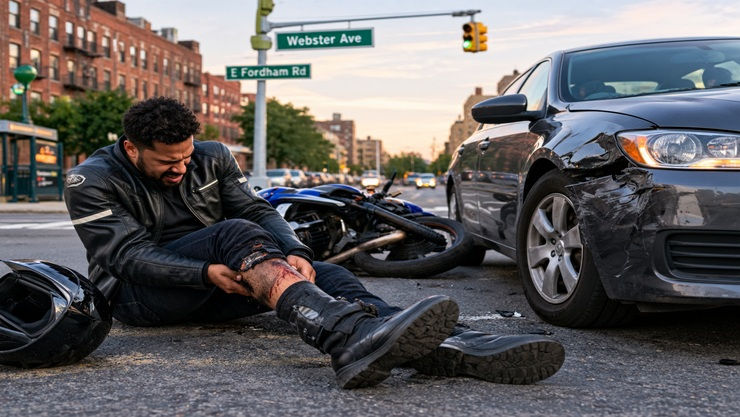
You're riding your motorcycle north on Webster Avenue in the Bronx on a clear evening. A sedan waiting at East Fordham Road suddenly cuts a left turn across your lane. You have no time. The impact crushes your lower left leg against the sedan's fender, and three surgeries later, doctors amputate below the knee. Then the insurance adjuster calls and says you were "going too fast" — so your case is worthless. That's a myth, and it's exactly the myth this article dismantles. Comparative fault in New York reduces your recovery by your share of the blame, but it never wipes your case out. Even a rider who is partly at fault can still recover millions for a leg amputation.
What Is Comparative Fault in New York and How Does CPLR § 1411 Work?
Comparative fault in New York means that if you're partly to blame for your own injury, your damages are reduced by your percentage of fault — but you are never barred from recovering. The rule comes from CPLR § 1411, which says that in a personal injury case, your own culpable conduct does not bar recovery; instead, the damages you'd otherwise receive are diminished in proportion to your share of the fault.
Lawyers call this a "pure" comparative negligence system. Pure means there's no cutoff. A rider found 30% at fault recovers 70% of the verdict. A rider found 60% at fault still recovers 40%. In theory, even a plaintiff found 90% at fault recovers 10%. Some states cut you off entirely once you cross 50% fault. New York doesn't. A handful of states still follow the old contributory negligence rule, where 1% of fault kills the entire case. New York abandoned that harsh approach decades ago.
There's a second piece most people never hear about. Under CPLR § 1412, your culpable conduct is an affirmative defense — meaning the defendant must plead it and prove it. You don't have to prove you were blameless. The driver who turned left across your path carries the burden of convincing a jury that you did something wrong and that it contributed to the crash.
We've written a broader plain-language guide to comparative negligence under CPLR § 1411. This post goes deeper on one specific, high-stakes application: the partially at-fault motorcyclist with a catastrophic amputation.
How Does a Left-Turn Motorcycle Crash in the Bronx Show Comparative Fault in Action?
The left-turn collision is the classic scenario where a seriously injured rider gets blamed — and where CPLR § 1411 saves the case. Under Vehicle and Traffic Law § 1141, a driver turning left must yield the right of way to any oncoming vehicle that is close enough to be an immediate hazard. When a driver turns across an oncoming motorcycle's lane, that driver has almost always violated the statute. That violation is powerful evidence of negligence.
But the defense rarely folds. Instead, the driver's insurer builds a comparative fault story: the rider was speeding, the rider was weaving, the headlight was hard to see, the rider could have braked sooner. According to NHTSA, motorcyclists are significantly more likely than car occupants to die in a crash — riders have no steel cage, so even a moderate-speed collision can destroy a limb. Defense lawyers know jurors carry assumptions about riders, and they lean into those assumptions hard.
Here's how the math actually plays out in a Bronx courtroom. Say your case goes to trial at Bronx Supreme Court on the Grand Concourse. The jury hears the evidence and awards $6 million: past and future medical care, lost earnings, and pain and suffering for the amputation. The jury also finds you were 30% at fault for traveling above the speed limit. The court reduces the award by your percentage, and you recover $4.2 million. The fault finding cost you money — but it didn't cost you the case. That's the entire point of comparative fault in New York.
Now flip it. Even if a jury pinned 60% of the blame on the rider — an aggressive allocation in a left-turn case — a $6 million verdict still produces a $2.4 million recovery. Compare that to a contributory negligence state, where the same rider walks away with nothing. The difference between those two outcomes is the difference CPLR § 1411 makes.
How Do Defense Lawyers Weaponize Fault Allocation Against Injured Motorcyclists?
Defense lawyers attack fault allocation because it's the only lever they have left when liability is clear — every percentage point they shift onto you is money directly out of your pocket. In a seven-figure amputation case, moving the jury from 10% plaintiff fault to 40% plaintiff fault saves the insurer almost two million dollars on a $6 million verdict. Expect them to fight for every point.
The playbook is predictable. Accident reconstruction experts will analyze skid marks, crush damage, and event data to argue you were speeding. Adjusters will comb your statements for anything that sounds like an admission. Investigators will pull up your riding history and your social media. In amputation cases specifically, defense investigators run surveillance for months — we've covered exactly how surveillance and social media are used against amputation plaintiffs, and why a single post can sink a serious injury case.
They'll also reach for the helmet argument, and here's where preparation matters. New York requires riders to wear helmets, and defense lawyers love to mention any violation. But experienced lawyers watch for a trap most riders never see coming: helmet non-use can only be used to reduce damages for injuries a helmet would have prevented — and a helmet does nothing to protect your leg, so in a below-knee amputation case the argument should be causally irrelevant and your lawyer should fight to keep it away from the jury entirely.
One more weapon works in your favor. In Rodriguez v. City of New York, 31 N.Y.3d 312 (2018), New York's highest court held that a plaintiff can win summary judgment on the defendant's liability without first disproving his own comparative fault. In plain terms: your lawyer can ask the judge to rule before trial that the left-turning driver was negligent, leaving the jury to decide only your percentage and your damages. That ruling changes the entire settlement dynamic, because the insurer knows it can no longer win outright — the only question left is how big the check will be.
How Much Is a Leg Amputation Case Worth After a Comparative Fault Reduction?
Even after a meaningful fault reduction, a below-knee amputation case in New York routinely remains a seven-figure case, because the underlying damages are enormous. A jury verdict in an amputation case is built from several components, and each one survives the percentage reduction:
Past medical expenses — the trauma care, surgeries, revisions, and hospital stays you've already endured
Future medical and prosthetic costs — prosthetic legs wear out and typically need replacement every few years for the rest of your life, plus fittings, socket adjustments, and physical therapy
Lost earnings and lost earning capacity — what the amputation takes from your working life, especially in physical trades
Pain and suffering — past and future, including phantom limb pain and the loss of the life you had
As the Cleveland Clinic explains, recovery from an amputation involves months of rehabilitation, prosthetic training, and often long-term complications like phantom pain and skin breakdown at the residual limb. A life care planner — an expert who projects your medical needs across your remaining life expectancy — will typically map out decades of prosthetic replacements, therapy, and home modifications. Those future costs alone often run well into seven figures for a younger rider.
We've broken down what an amputation injury is worth in New York in detail, but the comparative fault point bears repeating with numbers. If your total damages are $8 million and a jury assigns you 25% fault, you recover $6 million. At 50% fault, you still recover $4 million. The defense knows this arithmetic cold, which is why so much of the litigation is really a fight over percentage points rather than over whether you get paid at all.
Venue matters too. Most riders miss that where your case is tried can influence how jurors value pain and suffering and how they allocate fault — and Bronx County has long been regarded as a venue where jurors take catastrophic injuries seriously, which is one reason insurers evaluate a Bronx amputation case differently than the same case filed elsewhere.
What Should You Do After a Bronx Motorcycle Crash to Protect Your Recovery?
Protecting your recovery starts immediately, because the comparative fault fight begins the moment the insurer opens its file. Everything you say and do in the first weeks either shrinks or grows the percentage the defense will try to hang on you.
Don't give a recorded statement to the other driver's insurer. Adjusters are trained to extract phrases like "I didn't see him until the last second" that get replayed at trial as admissions of inattention. Let your lawyer handle all communications.
Preserve the evidence that fixes fault where it belongs. Many Bronx intersections are covered by NYC DOT traffic cameras, business security cameras, and MTA bus cameras, but that footage is routinely overwritten within days or weeks. A preservation letter sent early can capture video proving the driver turned directly into your path.
Watch the deadlines. A standard negligence claim generally must be filed within three years, but if the vehicle that hit you was a city bus, sanitation truck, or other government vehicle, you may have only 90 days to file a notice of claim — a trap we explain in our post on New York's 90-day notice of claim rule. And don't assume no-fault insurance will carry your medical bills indefinitely; motorcyclists are largely excluded from no-fault coverage in New York, and even covered claimants face the IME cutoff that ends benefits — which makes the lawsuit itself, and the fault percentage inside it, all the more important.
Finally, stay off social media. One photo of you smiling at a family barbecue becomes Exhibit A in the defense's argument that your suffering is exaggerated — and in a comparative fault case, credibility on damages and credibility on fault rise and fall together.
Frequently Asked Questions
Can I still recover if the police report says I was partly at fault?
Yes. A police report is not binding on a jury, and officers who didn't witness the crash often record only the driver's version. Under CPLR § 1411, even a finding of partial fault only reduces your recovery by your percentage — it never eliminates it.
What if the insurance company says I was 50% at fault for the crash?
You would still recover 50% of your damages under New York's pure comparative negligence rule. Keep in mind the insurer's percentage is a negotiating position, not a verdict — the actual allocation is decided by a jury, and the defendant carries the burden of proving your fault under CPLR § 1412.
Does not wearing a helmet hurt my leg amputation case?
Generally no, as to the amputation itself. Helmet non-use can only reduce damages for injuries a helmet would have prevented — head and brain injuries. A helmet has no causal connection to a crushed leg, and your lawyer should move to keep that argument away from the jury.
How long do I have to file a motorcycle injury lawsuit in New York?
Most negligence claims must be filed within three years of the crash. But if a government vehicle was involved — such as a city bus or sanitation truck — you may need to file a notice of claim within just 90 days, so speak with a lawyer as soon as possible.
Conclusion
Being partly at fault doesn't end a New York injury case — it only reduces it. Comparative fault in New York, under CPLR § 1411, guarantees that a motorcyclist who lost a leg in a left-turn collision can still recover a substantial, often seven-figure award even after the jury assigns some blame to the rider. The real battle is over percentage points, and that battle is winnable with the right evidence and the right strategy.
If you or someone you know suffered an amputation or other catastrophic injury in a motorcycle crash — even if you think you were partly at fault — the team at Yassi Law PC is ready to help. Call us today at 646-992-2138 for a consultation.
Written by Reza Yassi
This article is for informational purposes only and does not constitute legal advice. Although I am an attorney, I am not your attorney, and reading this article does not create an attorney-client relationship. Laws vary by jurisdiction and may have changed since the publication of this article. For advice specific to your situation, consult a qualified attorney.

.png)