
Nassau County Hospital Malpractice: Understanding the Unique Challenges of Suing NUMC

Updated: Aug 24
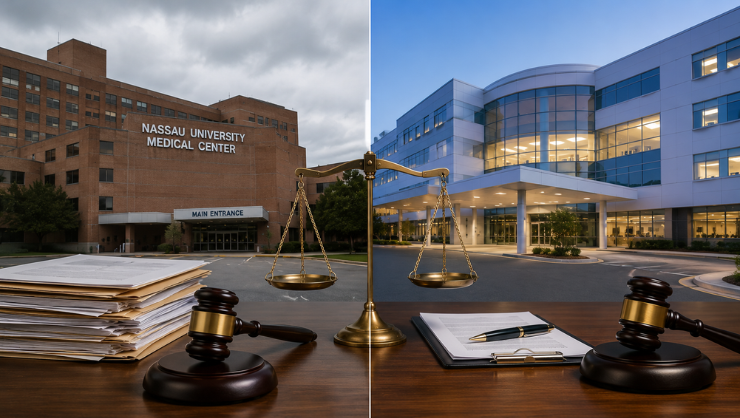
You scheduled a surgery at Nassau University Medical Center in East Meadow, expecting a normal recovery. Perhaps it was a hernia repair, a hysterectomy, or a colectomy. Instead, you woke up with an injury no one is explaining clearly — a perforated bowel, a severed bile duct, a nerve injury that left a leg weak, or an infection that turned septic. You think you have a malpractice case, and you may be right. However, Nassau County hospital malpractice claims against NUMC follow a completely different rulebook than claims against a private hospital like North Shore University Hospital or Mount Sinai South Nassau. Missing that distinction can end your case before it begins.
What Makes Nassau University Medical Center Different from a Private Long Island Hospital?
NUMC isn't a private hospital; it's run by a public benefit corporation. This single fact changes almost every deadline and procedural step in your case. The Nassau Health Care Corporation (NHCC) was created by the New York State Legislature under Article 10-C of the Public Authorities Law to operate NUMC, A. Holly Patterson Extended Care Facility in Uniondale, and a network of community health centers across Nassau County. NHCC is a legal entity separate from Nassau County itself, but it is treated as a public corporation for purposes of tort liability.
This public-corporation status matters because the rules that protect government entities from surprise lawsuits — the same rules that apply when you sue New York City or the MTA — also apply when you sue NUMC. You don't simply file a summons and complaint. First, you must give written notice of your claim within a tight window before you can file a lawsuit. If you treat your NUMC case the way you'd treat a malpractice case against a private Long Island hospital, you'll likely be out of court on a motion to dismiss before you ever see discovery.
NUMC is also Nassau County's primary safety-net hospital. It serves a high volume of Medicaid, uninsured, and trauma patients. Like other public safety-net hospitals on Long Island, it handles a substantial share of emergency surgical admissions. High volume and limited resources can correlate with surgical complication rates that are statistically meaningful. That pattern often shows up in the records when an experienced malpractice attorney pulls them.
Why Does Suing NUMC Require a Notice of Claim Under Public Authorities Law § 1744?
Because NHCC is a public benefit corporation, the Legislature built a special pre-suit notice procedure into Public Authorities Law § 1744. This statute governs tort actions against the Nassau Health Care Corporation. In plain English, that section requires you to serve a written notice of claim on NHCC before you sue, using the procedures laid out in General Municipal Law § 50-e.
A notice of claim is a sworn document that tells the public entity what happened, where it happened, when it happened, and what injuries you suffered. It's not a complaint, and it's not a demand letter. It's a statutory prerequisite. You generally must serve the notice of claim within 90 days of the date the malpractice occurred. Courts apply the continuous treatment doctrine narrowly in the notice-of-claim context. It may, in some circumstances, affect when the 90-day period begins to run, but you should not assume it will extend your deadline. The safest rule is to consult a malpractice attorney immediately after you suspect something went wrong, rather than waiting to see whether any tolling doctrine might apply. We cover the mechanics of the notice procedure in depth in our guide on how GML § 50-e can make or break a New York injury case, and the same playbook applies here with the added wrinkle of the Public Authorities Law layer.
If you miss the 90-day window, all is not necessarily lost. You can apply to the court for permission to serve a late notice of claim. The court weighs factors like whether NHCC had actual knowledge of the facts within 90 days, whether the delay prejudiced its ability to investigate, and whether you had a reasonable excuse. Hospital records that document the bad outcome — operative reports, post-op notes, complication entries — can establish that NHCC had actual knowledge from the moment the harm occurred. However, late-notice motions are uphill battles, and the safest path is to serve a proper notice on time.
How Do the Deadlines Differ for a Nassau County Hospital Malpractice Claim Against NUMC?
The most important deadline difference for a Nassau County hospital malpractice case against NUMC is not the statute of limitations; it's the mandatory 90-day notice of claim. For the underlying malpractice lawsuit itself, the statute of limitations under CPLR § 214-a is 2 years and 6 months from the date of accrual, the same as it would be against a private hospital like NYU Langone Long Island or Mercy Hospital in Rockville Centre. What makes NUMC different is that you cannot file that lawsuit at all unless you first served a timely notice of claim — and that notice deadline is 90 days from accrual, far earlier than the lawsuit deadline. Miss the notice deadline, and the longer statute of limitations becomes irrelevant.
Here's the rough timeline you're working with:
90 days from the malpractice: Serve a notice of claim on NHCC that complies with GML § 50-e. Do not wait, and do not assume any tolling doctrine will protect you — consult an attorney immediately.
Within a reasonable window after notice: Sit for a statutory hearing under GML § 50-h — a sworn examination by NHCC's lawyers about your claim.
2 years and 6 months from accrual: File the summons and complaint in Nassau County Supreme Court (subject to having timely served the notice of claim).
Throughout: Preserve every record — imaging, operative reports, pathology, discharge summaries — because these cases turn on documents written in real time.
Two specific traps catch even experienced practitioners. First, the date of accrual is not always the date of surgery. For a retained foreign object, for example, New York law provides a separate discovery rule. Note that for retained-object cases, the limitations period runs only 1 year from the date of discovery, which is actually shorter than the general 2½-year period. Thus, discovering the object late does not necessarily give you more time. For a misread biopsy, the accrual date can be the date of the negligent reading itself. Second, the GML § 50-h hearing is mandatory. If you refuse to appear, your case can be dismissed. NHCC's lawyers will use that hearing to lock in your version of events months before you've reviewed all the medical records, so preparation matters enormously.
Our deeper analysis of Nassau County medical malpractice venue strategy walks through how these timing rules intersect with jury tendencies on Long Island. A Nassau jury is generally more conservative on pain-and-suffering than a Bronx jury, which is why getting the procedural foundation perfect is even more important when you sue a public hospital authority here.
What Does a Nassau County Jury Expect from a Surgical Error Claim Against a Public Hospital?
A Nassau County jury expects clear, document-driven proof that a competent surgeon would not have done what your surgeon did, and that the deviation directly caused your injury. Juries in Mineola courtrooms tend to give doctors and nurses the benefit of the doubt unless the evidence is overwhelming. They want to see specific, named breaches — not vague allegations that "something went wrong."
The Expert Affirmation Requirement
Under CPLR § 3012-a, when a medical malpractice complaint is filed in New York, the plaintiff's attorney must file a certificate of merit. This certificate confirms that the attorney has consulted with at least one qualified medical expert who believes the case has a reasonable basis. This is the attorney's certification, not a sworn expert affirmation. However, in practice, it means your lawyer must have expert support before filing the complaint. Separately, at the summary judgment stage, you will need a sworn expert affirmation from a physician in the same specialty as the defendant to defeat a motion to dismiss the case on the merits. For surgical claims against NUMC, you typically need a board-certified expert in the same specialty as the operating surgeon — a general surgeon for a bowel case, an OB/GYN for a hysterectomy injury, or a vascular surgeon for a vessel injury during another procedure. Without that expert support, the case won't survive the first round of motions.
What the Records Have to Show
Your expert is looking for specific, identifiable deviations: an unrecognized injury to a duct or vessel during dissection, failure to perform an intraoperative cholangiogram when anatomy looked unclear, failure to convert from laparoscopic to open when visualization was poor, or failure to call for an intraoperative consult when something looked wrong. Categories of surgical adverse events — wrong-site surgery, retained foreign objects, intraoperative organ injury — are widely treated in the medical community as largely preventable. When one of those categories shows up at NUMC, the case has a strong starting point.
Causation Evidence
NHCC's lawyers will fight causation aggressively. They'll argue your underlying condition explains your current disability, that the complication was a known risk you consented to, or that subsequent treatment intervened. Defeating those arguments requires careful pairing of operative records, post-op imaging, pathology, and rehabilitation records. We dig into the verdict math on these cases in our roundup of New York medical malpractice surgical error verdicts. The pattern is consistent: clean, well-documented causation chains drive the seven- and eight-figure awards.
How Is a Life-Care Plan Built for a Catastrophic Post-Surgical Disability?
A life-care plan is the central damages document in any catastrophic surgical malpractice case. It's built by quantifying every future medical, rehabilitative, and personal-care cost the injury will demand over your statistical life expectancy. For a Nassau County hospital malpractice case where a surgical error left you with a permanent disability — such as a colostomy after a missed bowel injury, paralysis from intraoperative nerve damage, brain injury from anesthesia mismanagement, or dialysis dependence after kidney injury — the future-cost line item often eclipses the pain-and-suffering award.
A board-certified life-care planner, usually a rehabilitation nurse or physician with specialized credentials, works with your treating doctors to project decades of care. Categories typically include physician follow-up, surgical revisions, hospitalizations for complications, durable medical equipment, home modifications, in-home nursing or attendant care, medications, transportation to medical appointments, and assistive technology. Each item is priced using regional Long Island cost data and projected forward using inflation assumptions an economist will defend at trial.
The numbers can escalate quickly. Lifetime medical costs for a severe traumatic brain injury alone can be substantial, and that's before lost earnings. For someone left dependent on a ventilator or 24-hour attendant care after a surgical complication, in-home nursing in Nassau County can run $250,000 to over $400,000 per year, multiplied across a 30- or 40-year life expectancy. You can see how the framework comes together in our walkthrough of what a life-care plan looks like for a brain-bleed survivor in New York. The same methodology applies to a post-surgical catastrophic disability case.
One Nassau-specific consideration: public hospital defendants like NHCC sometimes argue for collateral-source offsets and present-value reductions more aggressively than private defendants because their reserves come from public funds. A well-built life-care plan anticipates those arguments by separating Medicare-covered items from non-covered items, including realistic deductibles and co-pays, and pricing services that Medicaid simply will not pay for in adequate quantity — particularly skilled in-home care. We explored similar damages-side strategy in our piece on NYC medical malpractice when hospital errors cause catastrophic injuries. The principles carry over to Nassau public-hospital cases with the added procedural overlay we've described.
If anesthesia management was part of what went wrong — delayed intubation, oxygen desaturation, medication errors — the analysis branches into a parallel track we walk through in our guide on how catastrophic anesthesia error cases are built. Many surgical-error claims against NUMC involve both surgical and anesthesia breaches, and both must be pled and supported by expert affirmations.
Frequently Asked Questions
Can I sue NUMC if I missed the 90-day notice of claim deadline?
Possibly, but you'll need to move quickly for permission to file a late notice of claim. You must show NHCC had actual knowledge of the facts within a reasonable time. Courts weigh prejudice to the hospital, your excuse for the delay, and whether the hospital's own records put it on notice of the malpractice. Don't assume you've lost — call a malpractice attorney immediately to evaluate a late-notice motion.
Does the continuous treatment doctrine apply to Nassau County hospital malpractice cases against NUMC?
Potentially, but courts apply the doctrine narrowly in the notice-of-claim context. If you continued treating with the same NUMC department for the same condition the surgeon mismanaged, the doctrine may in some circumstances affect when the 90-day notice clock begins to run and may toll the overall statute of limitations. However, you should not rely on this as a safety net. The records must show ongoing care specifically for the related condition, not just unrelated follow-ups. The law in this area is unsettled enough that you should contact a malpractice attorney immediately rather than assuming the doctrine extends your deadline.
Will my case be tried in Nassau County Supreme Court or somewhere else?
Cases against NHCC are typically venued in Nassau County Supreme Court in Mineola because that's where the cause of action arose and where the public corporation is located. Don't expect a transfer to a more plaintiff-friendly venue — venue rules generally lock these cases to Nassau, which is why understanding local jury tendencies is so important from the first day of the case.
How much is a Nassau County hospital malpractice case worth if the injury is catastrophic?
Verdicts and settlements in catastrophic Nassau County hospital malpractice cases against public hospitals routinely exceed $1 million. Serious cases involving permanent disability, paralysis, brain injury, or wrongful death can reach the high seven or eight figures. The amount depends on the strength of the liability proof, the credibility of the life-care plan, lost-earnings projections, and pain-and-suffering testimony. Public-defendant cases also involve negotiation over reserves and structured-payment terms that don't typically arise in private cases.
Conclusion
If you're hurt by a surgical error at a Nassau County public hospital, the procedural rules can end your case faster than the medicine ever could. A 90-day notice deadline and a mandatory pre-suit hearing both stand between you and the courtroom. Getting either of them wrong forfeits the claim. The good news is that with the right preparation, these cases can produce substantial recoveries for victims of genuine malpractice.
If you or someone you know was seriously injured by a surgical error at Nassau University Medical Center or another Nassau County public hospital, the team at Yassi Law PC is ready to help. Call us today at 646-992-2138 for a consultation.
This article is for informational purposes only and does not constitute legal advice. Although I am an attorney, I am not your attorney, and reading this article does not create an attorney-client relationship. Laws vary by jurisdiction and may have changed since the publication of this article. For advice specific to your situation, consult a qualified attorney.

.png)