
Consequential Damages in New York Breach of Contract Cases: A Guide for NYC Business Owners

Updated: Sep 15
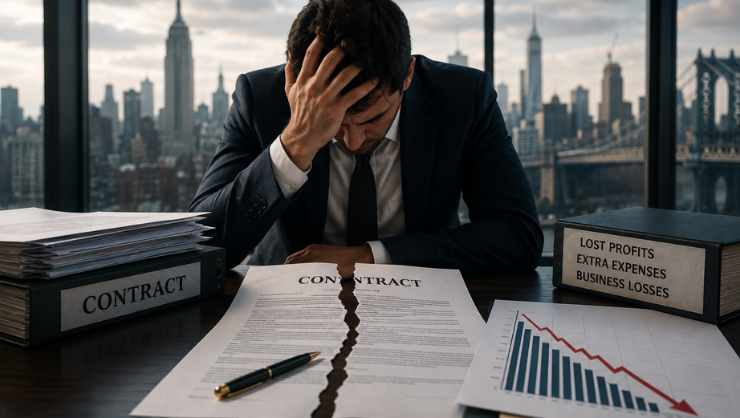
You run a specialty food import business in Long Island City. Your Italian pasta supplier misses the December delivery by six weeks. Whole Foods cancels its holiday order, three of your restaurant clients switch to a competitor, and your bank freezes your line of credit after your receivables tank. The undelivered pasta was worth $220,000. The damage to your business is closer to $3.8 million. Can you make the supplier pay for all of it?
That's the central question behind consequential damages in New York breach of contract cases. And it's one of the most misunderstood areas of commercial law — by business owners and, frankly, by a lot of lawyers too. Getting it right can mean the difference between recovering a few thousand dollars in refunds and recovering millions in lost enterprise value. At Yassi Law PC, we litigate these disputes across Manhattan, Brooklyn, Queens, Nassau, and Suffolk, and we've watched sophisticated businesses lose seven-figure claims because they didn't understand the rules going in.
What are consequential damages in a New York breach of contract case?
Consequential damages in a New York breach of contract case are losses that don't flow directly from the breach itself but result from the breach's downstream effects on your business. Think of them as second-order harm. If a supplier fails to deliver goods, the direct damage is what you paid or what it costs to buy replacement goods on the open market. The consequential damage is what you lost because you couldn't fulfill your own downstream contracts — canceled customer orders, lost profits, damaged reputation, foregone financing.
New York courts call these "special" damages, distinguishing them from "general" damages that arise naturally from any breach of the same type. Under well-established contract law, recovery for such damages is available only where the losses were reasonably foreseeable to both parties at the time they entered into the contract. The doctrine has been refined for a century and a half, but the core question hasn't changed: were the losses reasonably foreseeable at the time the parties made the deal?
The stakes are usually asymmetric. Direct damages in a $500,000 supply contract might be $50,000. Consequential damages arising from that same breach can easily hit $5 million if the breach cascades through a downstream customer relationship. That's why sophisticated defendants fight so hard to knock out consequential damages claims — and why plaintiffs fight to keep them in.
How do New York courts decide whether consequential damages were foreseeable?
New York courts apply a two-part foreseeability test to decide whether consequential damages are recoverable. First, the damages must have been reasonably foreseeable — or actually within the contemplation of both parties — at the time the contract was formed. Second, the damages must be provable with reasonable certainty, not speculation. Both prongs must be satisfied.
The leading modern authority is Kenford Co. v. County of Erie, 67 N.Y.2d 257 (1986), the domed-stadium case that killed a $63 million lost-profits verdict because the losses weren't in the parties' contemplation when they signed. Kenford is still the case defendants cite most often to defeat consequential damages claims, and it teaches a hard lesson: the mere fact that a loss was foreseeable in some abstract sense isn't enough. The court looks at what the parties actually communicated, negotiated, and understood when they signed.
That framework got a meaningful gloss in Bi-Economy Market, Inc. v. Harleysville Insurance Co. of New York, 10 N.Y.3d 187 (2008), where the Court of Appeals allowed consequential damages against an insurer whose delay in paying a business-interruption claim destroyed the insured's business. The court emphasized that when the very purpose of a contract is to protect against a particular kind of harm, damages flowing from that harm are foreseeable almost by definition. That reasoning has since been extended well beyond insurance contracts.
Practically, foreseeability is proven with pre-contract communications: emails, term sheets, LOIs, sales pitches, RFPs, and testimony about what each side knew about the other's business. If your Manhattan retailer disclosed during negotiation that they were sourcing exclusively from you for the holiday season, a Queens supplier's breach that wrecked the season is foreseeable. If they never mentioned it, the supplier has a real argument that the downstream damage was outside the deal's scope. This overlaps heavily with the analysis in our post on lost profits damages in New York breach of contract cases, since lost profits are the most common form of consequential loss.
Can a contract waive your right to consequential damages?
Yes, and it's one of the most-used defense tools in commercial litigation. New York generally enforces "no consequential damages" clauses in negotiated contracts between sophisticated parties. You've seen the language in almost every commercial agreement: "In no event shall either party be liable for any special, indirect, consequential, incidental, or punitive damages…" Boilerplate, but powerful. When enforced, it can eliminate 80% or more of the recoverable exposure in a large dispute.
Under UCC § 2-719, parties to a contract for the sale of goods may limit or exclude consequential damages unless the limitation is unconscionable. Outside the UCC, New York courts apply a similar rule under common law: waivers are enforceable unless they violate public policy, were procured by fraud, or would effectively excuse grossly negligent or intentionally wrongful conduct. The Second Circuit's analysis in Tractebel Energy Marketing, Inc. v. AEP Power Marketing, Inc., 487 F.3d 89 (2d Cir. 2007), remains a useful roadmap for how New York law treats these clauses in the energy and commodities context.
Two exceptions matter enormously in $1M–$10M disputes. First, a waiver won't shield a defendant from consequential damages caused by fraud or intentional misconduct. If you can prove the breach was tied to fraudulent inducement or willful default, the clause often collapses. Second, courts routinely wrestle with whether a particular category of damage is truly "consequential" or is instead a form of direct/general damage that survives the waiver.
Experienced commercial litigators watch for that second point closely — because a loss reframed as general damages can sidestep a consequential-damages waiver entirely. In American List Corp. v. U.S. News & World Report, Inc., 75 N.Y.2d 38 (1989), the Court of Appeals distinguished between lost profits that were the direct measure of a defaulting buyer's breach (general damages) and lost profits from collateral business arrangements (consequential damages). That distinction has been outcome-determinative in many post-Kenford disputes.
What evidence do you need to prove consequential damages at trial?
To prove consequential damages at trial in a New York court, you need documentary evidence establishing three things: foreseeability at the time of contracting, causation between the breach and the downstream loss, and the amount of the loss with reasonable certainty. Speculation and "lost opportunity" theories without hard numbers get dismissed on summary judgment.
The foreseeability evidence is usually pre-contract communications. Save every email, term sheet, RFP response, and pitch deck. If the other side knew what you were going to use their goods or services for — and especially if they knew who your downstream customers were — that knowledge builds the foreseeability record.
Causation is where consequential damages claims often die. If a Bronx wholesaler breaches and your business declines, the defendant will argue the decline was caused by market conditions, mismanagement, or unrelated factors — anything but the breach. You need contemporaneous business records showing that the specific customers you lost, the specific orders you couldn't fill, and the specific revenue you missed all trace to the breach. According to data published by the Federal Reserve Bank of New York's Small Business Credit Survey, small businesses in the tri-state area cite supply-chain disruptions and customer loss as top drivers of revenue declines — but generalized industry data won't carry your case. You need firm-specific evidence.
The amount of loss must be proven with reasonable certainty. For an established business with a track record, this is usually done through historical financials, expert accounting testimony, and comparable-period analyses. For a newer business, the Kenford problem looms: courts are skeptical of projected profits from unproven ventures. Expert testimony from a forensic accountant or damages economist is essentially mandatory in any consequential damages claim over $1 million. We've never seen a large consequential damages verdict survive appeal without expert damages testimony.
You also need to prove you mitigated. New York law requires the non-breaching party to take reasonable steps to reduce losses. If your Manhattan supplier defaulted and you could have covered from an alternate vendor at a modest markup but chose not to, expect the defense to argue that the downstream losses were self-inflicted. This is closely tied to the analysis we covered in our post on anticipatory repudiation — the moment you know the other side won't perform, your duty to mitigate kicks in.
One more procedural note: under CPLR § 213, you generally have six years from the breach to file a breach of contract action in New York. For sales-of-goods contracts under Article 2 of the UCC, the period is four years. Miss the deadline and even the strongest consequential damages theory dies on the courthouse steps.
How does Yassi Law PC handle consequential damages disputes in NYC?
At Yassi Law PC, we handle consequential damages disputes in NYC by front-loading the two things that decide these cases: the foreseeability record and the damages model. Most consequential damages in New York breach of contract cases are won or lost before discovery closes, so we invest heavily in the early phases.
On the plaintiff side, we start by mapping the pre-contract communications to establish what the other side knew about your business, your customers, and your exposure. We pair that with a damages framework built with a qualified expert — not a back-of-the-envelope spreadsheet. Judges in the Commercial Division see hundreds of damages models a year, and they know a serious one when they see it. If your model isn't defensible, expect a motion to strike your expert and, likely, summary judgment against you.
On the defense side, we scrutinize every element: was the loss really foreseeable, or is the plaintiff reverse-engineering foreseeability with the benefit of hindsight? Was the breach really the cause, or would the customer have left anyway? Are the projections built on a track record or on optimism? And does the contract's limitation-of-liability language do more work than the plaintiff is admitting? We also probe for related contract defenses — for example, whether the plaintiff itself materially breached first, an argument we explored at length in our post on material breach of contract in New York.
Most parties miss that whether the defendant acted in good faith can quietly shape whether courts enforce a consequential-damages waiver — because the implied covenant of good faith and fair dealing can support arguments that a bad-faith breach forfeits the protection of an otherwise valid limitation clause. That's a strategic pressure point in the biggest cases.
Finally, we think hard about how consequential damages interact with other remedy provisions. Contracts often stack a liquidated damages clause, a limitation on consequential damages, and a fee-shifting provision. Each of those interacts with the others in ways that dictate settlement value. And if a fee-shifting clause is triggered, the pressure to settle changes dramatically — a topic we cover in our guide to recovering attorney's fees in New York breach of contract cases.
Frequently Asked Questions
What's the difference between direct and consequential damages under New York law?
Direct damages are the losses that flow immediately and naturally from the breach — usually the difference between the contract price and the market price, or the cost of a substitute performance. Consequential damages are downstream losses that arise from your particular circumstances, like lost profits on collateral customer contracts. Most "no consequential damages" waivers try to eliminate the second category while leaving the first intact, but courts sometimes disagree with the parties about which is which.
What's the statute of limitations for a New York breach of contract claim?
Under CPLR § 213, most breach of contract claims in New York must be filed within six years of the breach. Contracts for the sale of goods governed by UCC Article 2 have a shorter four-year period. Missing the deadline typically bars your entire claim, including any consequential damages theory, so identifying the correct accrual date is one of the first things a commercial litigator should do.
Can I recover consequential damages if my contract has a limitation-of-liability clause?
Sometimes. Courts often enforce these clauses between sophisticated parties, but there are meaningful exceptions — including fraud, intentional misconduct, gross negligence, and situations where enforcement would leave the plaintiff with no meaningful remedy at all. Whether a particular loss is truly "consequential" (and therefore waived) or is instead a general damage (and therefore recoverable) is frequently contested in seven-figure disputes.
Do I need expert testimony to prove consequential damages at trial?
In any case above roughly $1 million, effectively yes. New York courts require damages to be proven with reasonable certainty, and lay opinion from the business owner rarely clears that bar for downstream lost profits or business-value diminution. A qualified forensic accountant or damages economist is close to indispensable in any serious consequential damages case.
The Bottom Line
Consequential damages in New York breach of contract cases are where the real money lives — and where the real fights happen. Foreseeability, causation, reasonable certainty, and the enforceability of waiver clauses will decide whether you recover millions or walk away with token direct damages. Building the record starts with the first email you send during contract negotiation and doesn't end until the damages expert takes the stand.
Written by Reza Yassi
If you or your business is facing a breach of contract dispute involving significant downstream losses, the team at Yassi Law P.C. is ready to help. Call us today at 646-992-2138 for a consultation.
This article is for informational purposes only and does not constitute legal advice. Although I am an attorney, I am not your attorney, and reading this article does not create an attorney-client relationship. Laws vary by jurisdiction and may have changed since the publication of this article. For advice specific to your situation, consult a qualified attorney.

.png)